
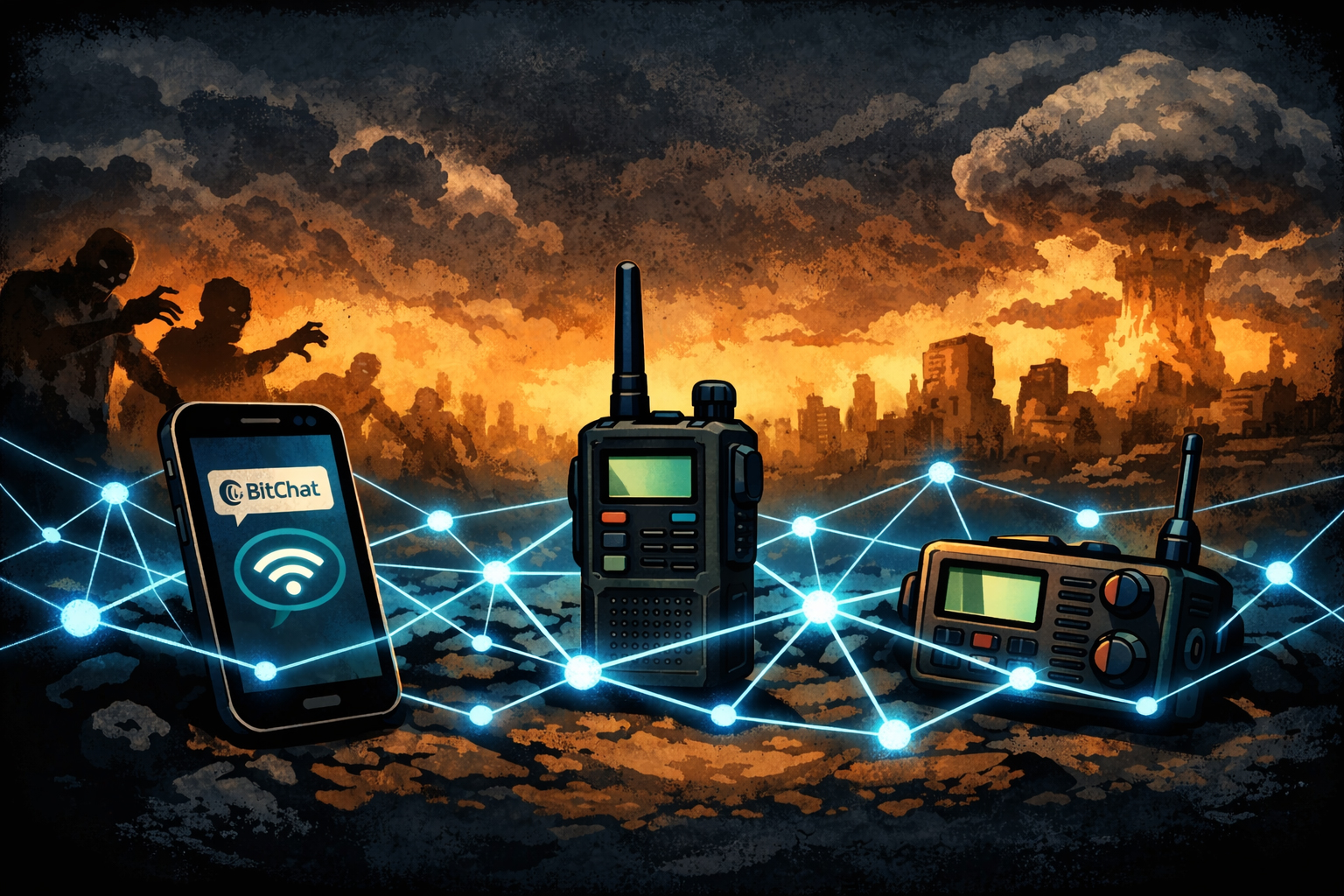
Let’s be honest: the modern internet is amazing… right up until it isn’t.
One DNS hiccup, power outage, cyberattack, solar flare, or unexpected zombie apocalypse, and suddenly your group chat, smart fridge, and cloud-based everything are about as useful as a screen door on a submarine.
So what do you do when the internet goes down—but you still want to communicate?
Today we’re looking at two alternative communication networks that don’t rely on the traditional internet, cell towers, or your ISP’s good mood. These are perfect for emergencies, disasters, off-grid adventures, or just preparing for a Mad Max–style Tuesday.
Network #1: BitChat (by Jack Dorsey)
Because yelling across the street is inefficient
BitChat is a decentralized messaging concept created by Jack Dorsey (yes, that Jack Dorsey). Instead of using the internet, BitChat uses Bluetooth to send messages directly between nearby devices.
Think of it like passing notes in class—but digitally, encrypted, and without the teacher confiscating them.
How It Works
- Uses Bluetooth Low Energy (BLE)
- Messages hop from phone to phone
- No internet, no servers, no phone numbers
- The more people using it nearby, the stronger the network
In a city, BitChat can form a mesh of phones that relay messages across surprisingly long distances—perfect for coordinating supply runs while avoiding zombies.
Pros
- No internet required
- Works with just smartphones
- Decentralized (no central server to go down)
- Great for short-range communication
Cons
- Range is limited (Bluetooth isn’t magic)
- Depends on other nearby users
- Still early / experimental
Getting Started with BitChat
- Bitchat Official Page
- Bitchat Github
- Download Bitchat for Android – Play Store
- Download Bitchat for iOS – App Store
Network #2: Meshtastic
For when you want to text your friends from 10 miles away during nuclear fallout
Meshtastic is where things get serious.
Meshtastic uses LoRa (Long Range radio) to create a true mesh network between small, low-power devices. These devices talk to each other over miles, not feet—without the internet, cell towers, or civilization.
Yes, this is the one preppers, hikers, and radio nerds absolutely love.
How It Works
- Uses inexpensive LoRa radios
- Messages hop device-to-device automatically
- Connects to your phone via Bluetooth
- Range can be several miles, more with good placement
You send a message on your phone → it goes to your Meshtastic device → the mesh network delivers it → someone else’s device receives it → their phone gets the message.
Pros
- Massive range compared to Bluetooth
- Extremely low power usage
- Works in rural, urban, and off-grid environments
- Open-source and well-supported
Cons
- Requires extra hardware
- Slower data rates (no memes… well, small memes)
- Setup takes a little tinkering
Getting Started with Meshtastic
You’ll need:
- A Meshtastic-compatible LoRa device
- The Meshtastic mobile app
Helpful links:
Which One Should You Use?
| Scenario | Best Choice |
|---|---|
| Urban blackout | BitChat |
| Music festival | BitChat |
| Hiking / camping | Meshtastic |
| Natural disaster | Meshtastic |
| Zombie apocalypse | Both |
| Nuclear fallout | Meshtastic (obviously) |
BitChat is great when people are close together and phones are plentiful.
Meshtastic is the clear winner when distance, reliability, and end-of-the-world vibes matter.
Final Thoughts
You don’t need to be a prepper, survivalist, or conspiracy theorist to appreciate alternative communication methods. These tools are:
- Fun to experiment with
- Useful in real emergencies
- A reminder that the internet is not guaranteed
And when everything else goes dark—no Wi-Fi, no LTE, no helpdesk ticket—you’ll still be able to send:
“All clear. Zombies avoided. Bring snacks.”
Which, honestly, feels like a win.
Stay safe. Stay nerdy. 📡